
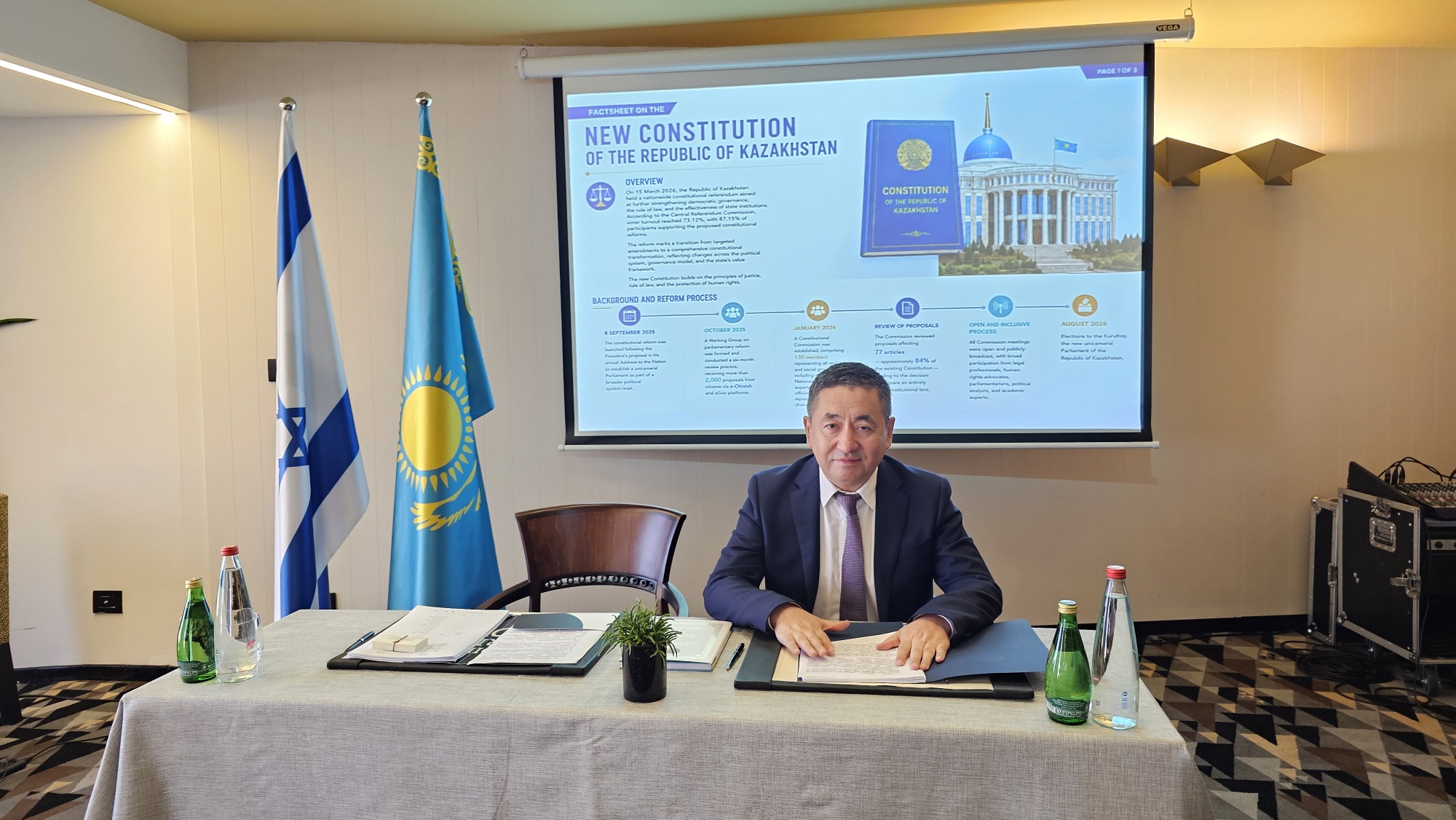
A distinguished diplomatic gathering hosted by the Embassy of Kazakhstan in Israel brought together diplomats, scholars, and journalists to review the nation’s historic constitutional reform adopted via nationwide referendum on March 15, 2026 and celebrate the rapid expansion of Kazakhstan-Israel relations.
His Excellency the Ambassador of the Republic of Kazakhstan, Mr. Daulet Yemberdiyev, presented the foundational changes aimed at modernizing public administration and strengthening democratic accountability. Central to this overhaul is the transition to the unicameral Kurultai, a streamlined 145 member single chamber parliament replacing the previous two-chamber system. With parliamentary elections scheduled for August 23, 2026, the constitutional framework introduces key new institutions, including a Vice President to ensure executive continuity, and the People’s Council (Halyq Qengesi)-a consultative body representing civil society with direct legislative initiative. Together, these reforms establish a rebalanced system of checks and balances by enhancing parliamentary oversight while maintaining an effective presidential governance model.
Ambassador Yemberdiyev reaffirmed Kazakhstan’s secular, multi-vector foreign policy and its positive engagement with the Abraham Accords framework. Highlighting unprecedented momentum in bilateral ties, the Ambassador noted recent high-level Israeli delegations to Kazakhstan including Knesset Speaker Amir Ohana, Ministers David Amsalem and Gideon Sa'ar, and President Isaac Herzog. A major milestone announced at the briefing is the finalization of a mutual 90-day visa-free regime, alongside ongoing progress on double taxation avoidance and direct flight routes.
The panel discussion provided rich academic, historical, and geopolitical insights into the partnership. Prof. Eduard Yakubov, President of the Holon Institute of Technology (HIT), underscored Kazakhstan’s strategic position as a bridge between East and West, paying moving tribute to the historical shelter Central Asian nations provided to hundreds of thousands of Jewish refugees during World War II who later helped build Israel. Emphasizing higher tech education as the core engine of national growth for Kazakhstan's young demographic, Prof. Yakubov detailed HIT's active collaboration with ten Kazakhstani universities and announced an upcoming delegation in October to establish a joint Technological Innovation Center focusing on AI, cybersecurity, digital health, and student exchange programs.
Complementing these academic perspectives, Mordechai Kimyogarov, Representative for Foreign Relations and International Cooperation of the World Congress of Bukharian Jews (honored within the community as its "Minister of Foreign Relations and Friendship of Peoples"), delivered a moving tribute to the historic and modern alliance between the Jewish people and Kazakhstan. Drawing on a 2,600 year history of peaceful coexistence in Central Asia dating back to the destruction of the First Temple, Kimyogarov highlighted the shared traditions, cultural bonds, and deep brotherhood between the two nations. He paid emotional homage to the Kazakh people's heroism during World War II both on the battlefronts and through their extraordinary humanitarianism in sheltering over one million refugees, including 200,000 European Jews, an act of generosity he stressed global Jewry must never forget. Turning to contemporary relations, Kimyogarov lauded Kazakhstan’s global leadership in interfaith dialogue-recalling his privilege of moderating a major interfaith congress in Jerusalem-as well as the flourishing bilateral cooperation spanning advanced medical training, defense technology, and trade. He praised Kazakhstan’s ongoing constitutional modernization and vibrant, educated youth, expressing full confidence in the nation's bright future under Ambassador Daulet Yemberdiyev's dedicated diplomatic leadership.
Adding a strategic analytical dimension to the panel, renowned political analyst and Central Asia expert Arkady Y. Dubnov offered a profound perspective based on 35 years of observing the post-Soviet landscape - an era now spanning half the lifetime of the USSR. Describing Kazakhstan as an extraordinary multi-ethnic state, Dubnov highlighted how Astana’s political trajectory actively challenges conventional, cynical views of diplomacy by reintroducing a rare moral dimension, decency, and ethical responsibility into international relations. Fully embodying its role as a constructive "middle power," Kazakhstan's foreign policy - exemplified by its open-minded engagement with initiatives like the Abraham Accords - demonstrates that principled, process-driven statecraft can serve as a beacon of optimism and a hub for a "new morality" in global politics.
Special appreciation is extended to Ambassador H.E. Mr. Daulet Yemberdiyev, Counsellor Assen Kashkenov, and the Embassy staff for their exceptional organization and gracious hosting of this diplomatic briefing.
Photos: Silvia G. Golan
More pictures available on Facebook (Israel Diplo / Diplomacy Israel / Silvia G. Golan) & Instagram (@SilviaGolan)
Lior Sattarov is a member of Debate for Peace. https://debateforpeace.org/


