
-
Home

- Art & Culture
Art & Culture
- Details
- Written by Hungarian Academy in Jerusalem

On the occasion of the 70th anniversary of the Hungarian Revolution of 1956, we warmly invite you to the following film screening at Cinematheque Tel Aviv!
Love on October 19, Monday, 20:30 PM
Hungarian feature film in black and white, 1970, directed by Károly Makk
(in Hungarian with Hebrew and English subtitles)
A young wife awaits the homecoming of her politically convicted husband. She cares for her mother-in-law and tries to maintain a semblance of normality. The two women form a special bond, nurturing hope in each other. Károly Makk linked two short stories by Tibor Déry, the principal defendant author on trial after the 1956 Revolution, to create one of the finest works in Hungarian cinema where the intimate world of the characters defies the storms of history. The film spoke of the fate of those suffering political persecution but everyone knew it was about the Kádár dictatorship.
Screening date: October 19, 2026, 20:30 p.m.
Venue: Cinematheque, Tel Aviv
Language: Hungarian with English and Hebrew subtitles
Length: 100 minutes
Tickets are now available on Cinematheque Tel Aviv's website:
https://www.cinema.co.il/event/%d7%90%d7%94%d7%91%d7%94-2/
We look forward to seeing you!
Üdvözlettel / Kind regards,
Jeruzsálemi Magyar Akadémia / Hungarian Academy in Jerusalem
- Details
- Written by Silvia Golan

The Embassy of India in Israel hosted a special tourism seminar yesterday, August 27, at the Indian Cultural Center in Tel Aviv, under the title “India Beyond Expectations – Nature, Luxury & Culture.”
The Embassy of India in Israel hosted a special tourism seminar yesterday, August 27, at the Swami Vivekanand Cultural Center in Tel Aviv (SVCC), under the title “India Beyond Expectations – Nature, Luxury & Culture.” The event brought together over 70 tour operators, representatives of tourism companies, tour guides and bloggers, travelers and India enthusiasts, offering participants an introduction to India from several different and complementary perspectives.
The first presentation, delivered by Cd’A Ms. Nayantara D Panda, focused on the Andaman and Nicobar Islands – a group of tropical and exotic islands offering spectacular beaches, nature and breathtaking landscapes, and still relatively unfamiliar to Israeli travelers.
Danny Avrahami, an India tourism expert, tour guide and lecturer with around 30 years of experience, dedicated his presentation to traveling in India with children, providing a comprehensive overview of the many destinations and attractions for family travel in India, from tiger and elephant safaris to exciting activities for young travellers across Rajasthan, Kerala, Karnataka, Goa, Leh & Ladakh.

The third presentation, by entrepreneur M.S Neta Adani, focused on architecture, art and luxury, taking the audience on a journey through the periods, styles and influences that have shaped India – from its various empires to contemporary architecture and design introducing luxury stays across India. Participants were introduced, among other things, fascinating connection between local traditions and the worlds of art, design and luxury hotels in modern India. Ms Neta Adani highlighted India’s magnificent architectural heritage and the diversity of styles that add to the country’s luxury tourism experience in Maharashtra, Delhi and Rajasthan.
The evening also featured performances by two artists from the SVCC Classical vocalist Ishan Dubey, performed a traditional Indian welcome song “Padharo Mhare Desh”, while Kathak artist Pratibha Sharma presented a classical piece “Vandana” followed by a special Kathak choreography to the Israeli folk song “Hava Nagila,” creating a unique artistic connection between Indian and Israeli culture.
The evening ended with participants relishing Indian cuisine including “Chaat” and “Samosa” and “Gajar ka Halwa”.
Credit for images: Embassy of India, Tel Aviv
- Details
- Written by Silvia Golan

Czech Film Week 2026 with a special screening of Franz, the latest film by acclaimed director Agnieszka Holland.
Mon 27. 7. 2026 – Fri 21. 8. 2026
Inspired by the life and imagination of Franz Kafka, Franz is a visually striking and deeply engaging portrait of one of the world's greatest literary figures. We are especially honoured to welcome the film's lead actor, Idan Weiss, who will attend the screening and join the audience for a post-screening Q&A in Tel Aviv and Jerusalem.
This year's Czech Film Week also presents a carefully curated selection of outstanding Czech films, combining acclaimed contemporary productions with timeless classics. Audiences can look forward to the heartwarming comedy Sea of Hope, the inspiring sports drama Invincibles, and a tribute to legendary filmmaker František Vláčil with screenings of his masterpieces Marketa Lazarová and The Valley of the Bees. Together, the program offers a rich journey through the diversity, creativity, and enduring legacy of Czech cinema.
We look forward to welcoming you to another celebration of Czech cinema and sharing these remarkable films with you on the big screen.
The full festival programme, screening schedule, and all practical information can be found on our website.
This July and August, cinematheques across Israel will once again host the traditional Czech Film Week festival. The festival will begin on July 27 and, as every year, will offer audiences a selection of Czech cinema from the 1960s to the present day.
The main section of this year's festival aims to showcase contemporary Czech filmmaking. All three selected films were produced in 2025 and demonstrate the thematic and genre diversity of current Czech cinema. The second part of the festival will present a retrospective dedicated to František Vláčil, one of the greats of Czech cinematography.
The centerpiece of this year's festival is the Czech-Polish-German co-production Franz (2025). Director Agnieszka Holland assembles a kaleidoscope of events from fragments, dreams, letters, and preserved stories into a compelling narrative inspired by the life, work, and imagination of writer Franz Kafka. This ambitious film presents Kafka's life and personality from an entirely new perspective and on unexpected levels.
Another featured film is the drama The Invincibles (2025) by young director Dan Pánek. Inspired by true events, it tells the fascinating story of three people at crucial turning points in their lives: a successful businessman trying to save his family, a bitter coach whose world is on the brink of collapse, and a promising athlete who is stabbed by attackers while defending another man. Their lives intersect in a story about determination, strong will, and second chances in life. The film will also introduce Israeli audiences to the beauty of ice hockey, the Czech Republic's national sport.
The third film is the romantic comedy Sea of Hope (2025), directed by Martin Horský. It tells the story of an aging violin maker who spends his life safely within his workshop and among a close circle of friends—until a life-changing event turns everything upside down and prompts him to pursue his dreams before it is too late. Set against the beautiful backdrop of historic Prague, this stylized film delights not only with its warm atmosphere but also with performances by some of the most popular Czech actors of today.
As part of the František Vláčil retrospective, audiences will have the opportunity to see two of his most acclaimed films: Marketa Lazarová (1967) and The Valley of the Bees (1967), both set in the distant Middle Ages.
Marketa Lazarová, a cornerstone of Czech cinema, is regarded as one of the most significant historical films of all time. The story follows the fate of a virtuous young woman destined for life in a convent, who is instead forced to become the lover of a violent young man. The film captivates with its striking visuals, inventive sound design and musical score, and frequent visions and memories of its characters, which disrupt the linear narrative.
The Valley of the Bees depicts the conflict between enforced membership in an ascetic crusading order and the desire for a free life. The fanatical knight Armin von Heide pursues his friend, the young nobleman Ondřej, who has fled the order and returned to his ancestral estate. Determined to punish him for violating the order's rules, the knight seeks to destroy his attempt to build a normal and happy life.
Partners of the event: Embassy of the Czech Republic in Tel Aviv, NFA - Národní filmový archiv, Cinematheque Haifa, Herzliya, Jerusalem, Rosh Pina, and Tel Aviv.
www.facebook.com/CzechCentreTelAviv
www.instagram.com/czechcentretelaviv/?hl=de
- Details
- Written by Gil Zohar
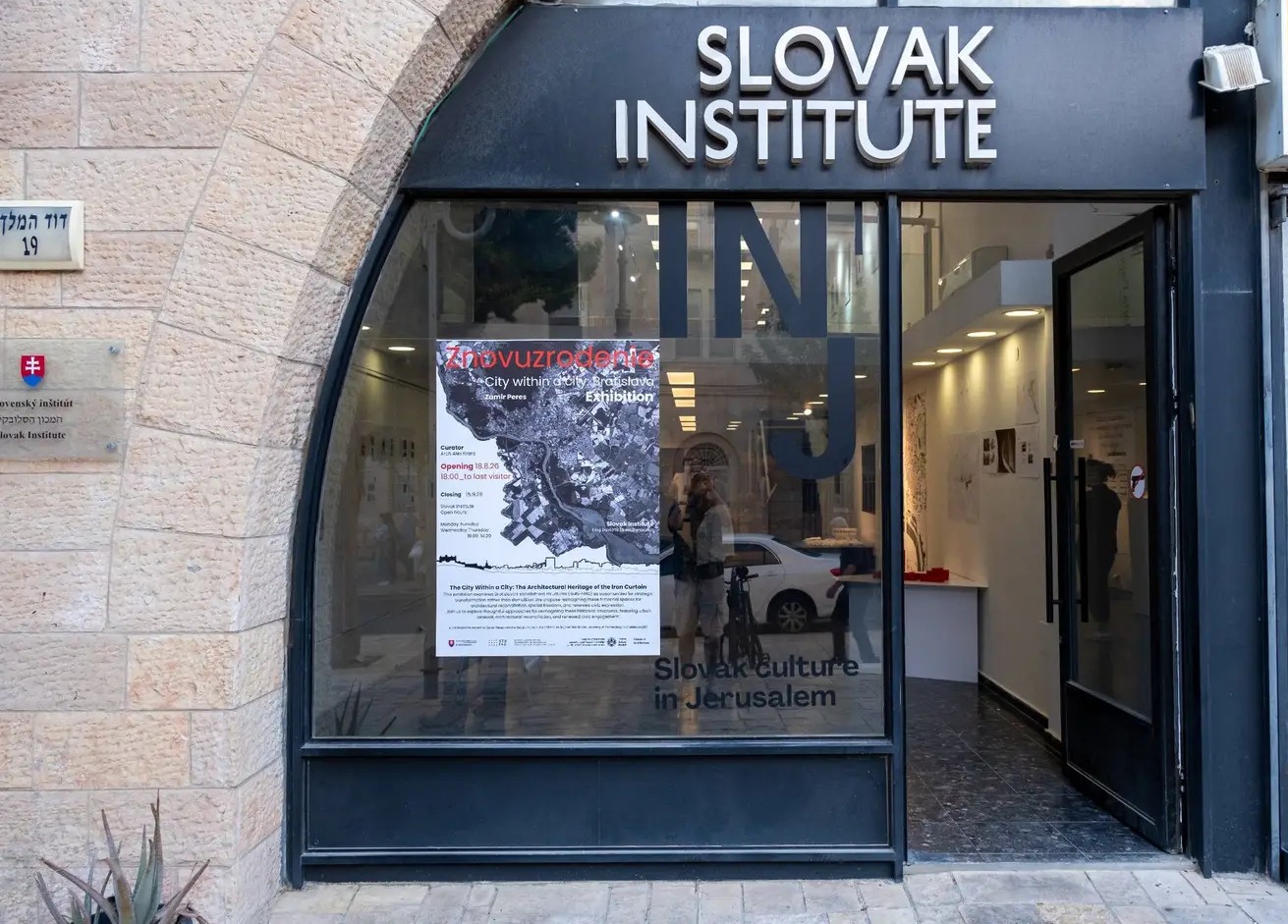
A temporary exhibit on the brutalist architecture of Bratislava during the city’s Communist era (1945-1990) opened August 18 at Jerusalem’s Slovak Institute. Called “A City Within A City: Bratislava Architectural Heritage of the Iron Curtain”, the exhibit of models and photographs examines the monumental Soviet-inspired concrete structures in the Slovak capital as opportunities for strategic transformation rather than demolition. It proposes reimagining these historical spaces for architectural reconciliation, spatial freedom, and renewed civic expression.
A City Within A City is a collaboration curated by Zamir Peres with the Bezalel Academy’s School of Architecture in Jerusalem and Alex Krantz of the Slovak University of Technology in Bratislava.
Today the capital of independent Slovakia, Bratislava – a historic Danube River port midway between Vienna to the west and Budapest to the east – has been the scene of a series of seismic political, urban and demographic changes in the last two centuries. The name "Bratislava" originates from the Slavic personal name "Braslav," meaning “glorious defense” or “city of defense.” The modern name was officially adopted in 1919 after the establishment of Czechoslovakia, as part of a movement to revive the Slavic city’s heritage.
During the Austro-Hungarian Empire, the cosmopolitan and polyglot city was called Pressburg in German and Yiddish, whence Prešporok in Slovak and Prešpurk in Czech, and Pozsony in Hungarian. It was a glittering rival to Prague. Following WWI and the collapse of the Habsburg empire, Bratislava became part of nascent Czechoslovakia. During the Nazi period, it was the capital of Jozef Tiso's vassal fascist state before falling under Josef Stalin’s boot in 1945. In 1993, following the peaceful dissolution of the Czech and Slovak federation, Bratislava became the capital of newly independent Slovakia.
While all those periods together have left a rich historic and architectural fabric, many consider the Communist era buildings as ugly Socialist relics and a foreign intrusion in the city, said Peres. In particular, the concrete structures in and near the historic Old Town are especially glaring and ill-conceived, he noted.
The Hotel Kyjev, located on the Kamenné Námestie in the former Jewish neighborhood in the capital’s heart, fails to integrate with its older surroundings. Comparing the half-abandoned tower to Tel Aviv’s cavernous and under-utilized Central Bus Station, Peres called it a “mausoleum”.
Built in 1973, it was inspired by Danish architect Arne Jacobsen’s SAS Royal Hotel in Copenhagen. Both buildings have been criticized for their lack of urban context. The SAS Hotel has been compared to a pack of cigarettes. Critics have been no kinder in describing the Hotel Kyjev. Both buildings replaced historical landmarks with striking brutalist structures, raw concrete facades, and rigid geometrical if functionalist design. Standing 65 meters and soaring 15 floors, the Hotel Kyjev is among the tallest – and arguably ugliest – buildings in Bratislava. Its interiors were originally decorated in a retro-futuristic 1970s aesthetic that has aged badly.
Equally anachronistic is the OD Prior shopping center which opened in 1968. Designed by Ivan Matúšik, it was the first indoor mall in the former Czechoslovakia and had the country’s first escalators.
Another obsolete brutalist monstrosity stands nearby on Medená Street, a few steps from Kamenné Námestie and the nearby Comenius University. The residential building erected in 1974 consists of terraces with supporting columns. Today its striking if faded yellow decoration has been defaced with graffiti. Its architects Ján Hauskrecht and Štefan Svetko saw the 1960s and early 1970s as years of loosening Bratislava’s conservative social atmosphere. They envisioned their post-modern apartment bloc as part of a brave new world turning its back on Bratislava’s architectural and political legacy.
Of special interest for this author is the Most SNP, (Bridge of the Slovak National Uprising"), commonly referred to as the UFO Bridge for its futuristic design. Built between 1967 and 1972 by architect J. Lacko and engineer A. Tesár, the bridge required the demolition of the neo-Moorish Neolog Synagogue which was built in 1893 and designed by Dezso Milch. Symbolizing fin-de-siecle modernity and equality in the dying Austro-Hungarian Empire, the synagogue with its two octagonal onion dome towers was constructed on Fish Square adjacent to St. Martin's Cathedral. It was replaced by an 85-meter-high tower with an observation deck and restaurant which many people have compared to a flying saucer.
Of the more than 15,000 Jews living in Bratislava in 1939, 3,500 survived World War II. Having outlasted the Nazi onslaught and the Holocaust, the city’s landmark synagogue was demolished to make room for a structure some saw as extolling the USSR and its cosmonauts.
Rather than tearing down the city’s Soviet-era city center towers, Peres called for the buildings to be stripped down to their steel core allowing them to be repurposed and reused.
The exhibit will be on display until September 15, Monday to Thursday from 10:00 until 14:00, at Jerusalem’s Slovak Institute, 19 King David Street,
Photos credit Zamir Peres
Gil Zohar
www.GilZohar.ca
www.GilZohar.ca
- Details
- Written by Silvia Golan

The Jerusalem Film Festival, Israel's leading film event, will be held for the 43rd time from July 9-19. The festival will open at the Sultan's Pool with the premiere of "Independence," directed by Moshe Rosenthal ("Karaoke").
The festival's international program includes dozens of full-length films - feature films, documentaries and experimental films, screened in a series of settings.
The full program is available on the festival website
The program includes many notable films from the past year, including the Palme d'Or winner and the Golden Bear winner, along with the big winners of the world's most significant international festivals such as San Sebastian, Toronto, Tallinn, SXSW, Tribeca and Rotterdam.
The films will be screened in the four halls of the Jerusalem Cinematheque, and in the Lev Smadar Cinema. This year, the festival will host over 20 international guests, including directors, producers and actors from all over the world.
This year, over three-quarters of the international curated films in the program are exclusive to the Jerusalem Film Festival, a unique opportunity to view them in Israel.
This edition of the festival will also feature award-winning competitions for international cinema: the International Competition, the International Debut Competition, the In the Spirit of Freedom Competition, and the Chantal Ackerman Competition.
Alongside the official competitions, international films will be screened in a variety of additional settings, including: Masters and Masters, Panorama, Gala, Cinemania, Midnight Films, Classics, and Art at the Intersection.
The festival's international program settings:
The International Competition - the festival's main competition for international cinema. Debuts - an international competition that looks to the next and most promising generation of cinema art. In the Spirit of Freedom - an international competition for works that deal with man's eternal pursuit of freedom and justice. Chantal Ackerman Competition - a competition for international films that deal with an event or a true story through innovative and experimental means.
On the Radar - the promising and intriguing voices of international cinema in fiction and documentary. Masters and Masters - new films by renowned and influential directors in the field of cinema. Panorama - acclaimed films from around the world. Gala - festive premieres • films with movie stars • films for a wide audience. Losing It - wild films that walk on the edge.
Cinemania - films that deal with the love of cinema and the stories behind the great films and filmmakers. Classics - new and restored tributes and copies of unforgettable masterpieces. Art at the Crossroads - a framework for experimental cinema in collaboration with the "Mamatoa" Art and Media Center.
Among the notable international films that will be screened at the festival
"Fjord" - winner of the Palme d'Or at the Cannes Film Festival. Christian Monjou's film ("4 Months, 3 Weeks and 2 Days"), with the participation of Oscar nominees Sebastian Stan and Renata Rainsev.
"Yellow Letters" - winner of the Golden Bear at the Berlin Film Festival. A film by Ilker Cetak (Oscar nominee for "The Teachers' Room").
"Fatherland" - Pawel Pawlikowski's new film, winner of the Cannes Film Festival's Best Director Award.
"La Bola Negra" - Winner of the Cannes Film Festival's Best Director Award. A timeless epic produced by Pedro Almodóvar.
"Hercules Falling" - Winner of the Tallinn Film Festival's Best Debut Film and International Critics' Award, starring Dar Salim ("Game of Thrones").
"A New Dawn" - An anime film from the official competition of the Berlin Film Festival.
"Paper Tiger" - James Gray's new film, starring Adam Driver and Scarlett Johansson, from the official competition of the Cannes Film Festival.
"The Dreamed Adventure" - Winner of the Cannes Film Festival's Jury Prize.
"A Man" - A Man of his Time
Winner of the Cannes Film Festival Screenplay Award.
Barrio Triste – The debut film of Stills, director of the Bad Bunny music videos, from the Venice Film Festival’s Orizont program.
Skateboarding is not for Girls – Winner of the Tribeca Film Festival’s Nora Ephron Award for Best New Director.
And Her Body Was Never Found – A suspense drama by Polaris Banks and Moore Cohen, from the SXSW Festival program.
The Samurai and the Prisoner – Kiyoshi Kurosawa’s new film, an official selection of the Cannes Film Festival.
Broken Voices – Winner of the Karlovy Vary Film Festival’s Best Actress Award.
Iron Boy – Animation, winner of the Jury’s Special Prize in the Un Certain Regard section of the Cannes Film Festival.
Robert Richardson: The White Devil – An extraordinary documentary about the legendary cinematographer (“Kill Bill”, “Platoon”, “Shutter Island”), straight from its premiere in Karlovy Vary.
Rose – A stylish period drama that brought Sandra Haller the Best Actress Award at the Berlin Film Festival.
Ivan & Hadoum – Winner of the Berlin Film Festival Teddy Award.
Silent Flood – Winner of the IDFA Film Festival Cinematography Award.
Trial of Hein – A unique historical drama from the Berlin Film Festival’s Perspective Competition for First-Time Films.
Their Town – A coming-of-age drama from the makers of “Lost in Baltimore”, from the SXSW Film Festival lineup.
My Wife Cries – Angela Schnellek’s new film, from the official competition of the Berlin Film Festival.
Nagi Notes – Koji Fukada’s new film, from the official competition of the Cannes Film Festival.
Another Day – A stunning performance by Adele Exercopole in a drama from the official competition of the Cannes Film Festival.
No Mercy – A documentary examining the cinema created by female directors over the years, with the participation of Celine Sciamma, Catherine Brey, Anna Lili Amarpour, Alice Diop and more.
The Christophers – Steven Soderbergh’s new film starring Ian McKellen.
In the Land of Arto – A travelogue starring Kami Kota and Raz Amir Ibrahimi (“Tatami”).
"The Red Rocks" - Bruno Dumont's surprising new film, from the Directors' Fortnight at the Cannes Film Festival.
"The Day She Returned" - The new film by South Korean master Hong Sang-su, from the Berlin Film Festival program.
"Noga" - A documentary about Israeli musician Noga Erez, screened at the Tribeca Film Festival.
The classics will include:
A tribute to Roberto Rossellini - with the new documentary by the Italian master ("Roberto Rossellini: Living Without a Script" winner of the Donatello Award) we will screen four of his greatest works: the documentary "India: Mother Earth", "Germany Year Zero", and "Fear" and "Journey to Italy" starring Ingrid Bergman. "3:10 to the Moon" - A new restoration of the classic Western. "The Promised Land" - A new restoration of Andrzej Wajda's magnificent film, which was nominated for an Oscar for Best International Film.
"Dead Travelers Hotel" – A New Restoration of the Lost Soviet Cult Film.
About the Jerusalem International Film Festival 2026:
The Jerusalem Film Festival will take place this year from July 9-19. The festival will present a rich artistic program that includes dozens of film premieres from around the world, first exposure of the best of Israeli cinema, as well as talkies that have won awards at leading festivals in the world, including Berlin, Cannes, Tribeca, IDFA and others.
The Jerusalem Film Festival, conceived and initiated by Israel Prize laureate and founder of the Jerusalem Cinematheque, Lia van Leer, is considered a leading and important film festival in Israel, enjoys a prestigious status in the international arena and has established itself as one of the leading film festivals in the world. The festival is expected to attract approximately 70,000 film and culture enthusiasts from Israel and around the world, and invited guests from the international film industry, along with Israeli film professionals, including actors, directors, producers, festival directors, film fund directors, and more.
Festival Director: Roni Mahadav-Levin, Artistic Director: Or Sigoli.
The Jerusalem Film Festival is held with the support of the Ministry of Culture, the Van Leer Foundation, the Jerusalem Foundation, and the Jerusalem Municipality.
Full details, screening dates, and ticket reservations - via the festival's official website https://jff.org.il/he
Photo credit: "Courtesy of the Jerusalem Film Festival"


